|

|
 |
|
Freeze Drying Machines |
|
The success of the freeze-dry process and the future of
freeze-dry technology depend in large part on the skill of
the practitioner and the dependability of the freeze-dry
machine to get the job done right - for whatever
application it is used. It is the responsibility of the
freeze-dry practitioner to have the required skill to use
the process successfully, but it is the responsibility of
the manufacturer to build a machine that will incorporate
dependability and efficiency. |
|
|
|
Proper engineering and high quality construction must
be present in a machine if it is to operate continuously,
day after day for long periods of time. With these
criteria in mind, Freeze Dry World reviewed the L-3666
"Production" model built by Northern Freeze Dry
Manufacturing of Pequot Lakes, Minnesota. the l-3666
derives its model number from its specimen chamber
dimensions - 36" in diameter, 66" in length. |
|
|
|
Northstars Workhorse with a Proven Track Record |
|
|
|
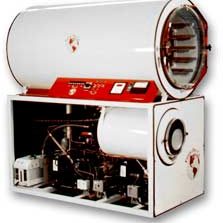
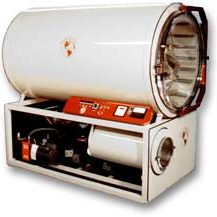
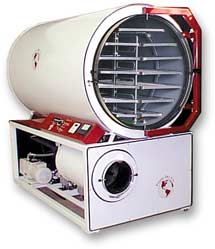
From the standpoint of appearance, the freeze dry machine L-3666 is
attractive, sturdy, and business like. the wood-grain
panels contrast nicely with the bright blue metal work.
The units physical design is neat and compact. All
components, including the condenser tank fit snugly inside
the frame, which supports the specimen chamber. |
|
|
|
All control switches and gauges, including the specimen
chamber thermostat and vacuum release lever, are clustered
neatly at the front of the freeze dry machine, allowing
operation of the machine from one position. The main
control switches serve power to the condenser
refrigeration compressor, vacuum pump, and interior light.
to the left of the switches is a dial timer that activates
the defrost cycle for the condenser temperatures of both
condenser and specimen chamber are read on a LED
electronic digital gauge with a dual position switch. The
electronic vacuum gauge measures atmospheric pressure
within the vacuum system in microns (normal atmospheric
pressure is a approximately fifteen pounds per square
inch, which equals 760,000 microns. The sublimation
process begins at 675 microns with the specimen chamber at
-5 degrees F). The L-3666 is designed to draw down to 25
microns or less (empty unit). At this pressure, more than
99.9 percent of the air has been removed from the specimen
and condenser chambers. The vacuum system must be
absolutely leak-proof and strongly built in order to
maintain these vacuum levels. |
|
|
|
Norhtstar has developed a door system that allows full
view of the inside of the specimen chamber while at the
same time ensures an airtight seal. A heavy steel ring is
welded to the end rim of the freeze dry machine chamber, it's
exposed edge is sanded smooth, then covered with a thin
coat of vacuum grease. A heavy duty rubber gasket is then
capped over the ring. The front edge of the gasket is also
coated with vacuum grease. a massive Plexiglas door, held
by a sturdy hinge system, is then pressed against the
gasket for a few seconds after the vacuum pump is turned
on to seal the chamber. This same closure system of
Plexiglas door against gasket is used on the condenser
chamber door as well, but on a smaller scale. |
|
|
|
Freeze Dry Machine Vacuum and Refrigeration |
|
|
|
The vacuum for both the specimen and condenser chambers
is achieved by one pump; a 1-1/2 horsepower motor that
evacuates at the rate of 26.8 cubic feet per minute.
Since the condenser and specimen chamber are on the same
line, they draw down simultaneously. |
|
|
|
The specimen chamber and condenser each have their own
refrigeration system, which allows temperature in the
condenser to reach -55 degrees F or colder, while the
specimen chamber is thermostatically-controlled for a
range of temperatures compatible with particular
freeze-dry processes. The temperature difference between
specimen chamber and condenser sets up the condition
whereby moisture in the form of vapor is drawn out of
the specimen chamber and collects as frost on the colder
condenser wall, a phenomenon similar to water condensing
out of warm air and collecting as water on the side of
an iced drink glass on a summer day. However, in the
case of the freeze-dry machine, the moisture that
originates in the specimen never takes the form of
water. It passes from the ice crystal state to a vapor
and then back into frost. |
|
|
|
When enough moisture is withdrawn from the specimen
chamber to accumulate 1" to 2" of ice in the condenser
chamber, the defrost cycle is begun. The L-3666 employs
a quick and efficient hot-gas defrost system. Within
approximately 15 minutes from the beginning of the
defrost cycle, the condenser wall is warm enough to
produce a layer of water between the wall and the
accumulated cylinder of ice, which can then be extracted
and discarded. |
|
|
|
A Little Ummph |
|
|
|
The machine gets its "Production" name for its 37.5 cubic
feet of freeze-drying capabilities. It has been used by
taxidermists for freeze-drying a wide variety specimens,
from insects and small rodents up to life size bears.
Although it is a fairly large machine, it can be moved
around on level floors quite easily on its casters-with
a little extra ummph. |
|
|
|
Maintenance |
|
|
|
Maintenance of the freeze dry machine, as covered in its operating
manual, consists mainly of changing oil in the vacuum
pump and keeping the refrigeration coils clean. The
manual also covers freeze dry basic theory; features of
the machine; set-up, start-up, shutdown, and defrost
procedures; and troubleshooting. |
|
|
|
The L-3666 "Production" has evolved into being
Northstar's most popular unit over the years, and it
appears that it will continue as the workhorse of the
Northstar line. |
|
|
|
|